
A lot of patients who need full-arch dental reconstruction also have something else in common: a history with substances that makes the thought of sedation deeply uncomfortable. Years of stable recovery from opioid addiction, an old benzodiazepine dependence, a stretch of heavy drinking that ended a decade ago. The fear is usually not the surgery itself. It is the IV line, the medications used to keep a patient comfortable during four to six hours of full-arch work, and the prescription pain medication that follows. The fear that one well-meaning sedation protocol could undo years of recovery is real, and it keeps people from getting dental care they badly need.
The good news is that All-on-4 surgery can be done safely for patients in recovery, and oral surgeons who handle these cases routinely have well-established protocols for protecting sobriety while still keeping the patient comfortable. The bad news is that those protocols only work if the patient discloses the history up front, and many patients do not, either out of stigma or out of fear of being refused care.
This guide covers what sedation is actually used during All-on-4, how each option interacts with a history of addiction or with medication-assisted treatment, what the post-operative pain plan can look like without narcotics, what to disclose and how, and how to find an oral surgeon experienced with recovery patients.
Why does past drug use affect All-on-4 sedation planning?
All-on-4 surgery is a multi-hour procedure that involves extracting any remaining teeth, placing four to six implants, and seating an immediate temporary bridge, all in a single appointment. The standard sedation pathway in most clinics is IV moderate sedation or deep sedation, often combined with local anesthesia at the surgical sites, and followed by a short course of prescription pain medication for the first few days of recovery.
For a patient with no addiction history, that protocol is straightforward and well-tolerated. For a patient with a history of opioid use disorder, alcohol use disorder, benzodiazepine dependence, or stimulant addiction, several things change at once:
- Tolerance to sedatives or opioids may be higher than expected, even years into recovery, which means standard doses can be either ineffective or harder to dose safely.
- Certain sedation drugs (particularly benzodiazepines and opioid analgesics) can trigger cravings, anhedonia, or relapse risk in the days and weeks after surgery.
- Patients on medication-assisted treatment (MAT) with buprenorphine (Suboxone, Subutex, Sublocade), methadone, or naltrexone (Vivitrol) have specific, clinically significant interactions with sedation and post-op pain medications that must be planned for in advance.
- The patient's broader recovery support system, including a sponsor, addiction medicine provider, or therapist, often needs to be looped in before and after the procedure.
None of this disqualifies a patient from All-on-4 surgery. It does mean the sedation plan should be built specifically for them, not pulled off the standard template. A surgeon who treats this conversation as routine, asks the right questions, and adjusts the protocol accordingly is the kind of surgeon you want. A surgeon who waves it off as "no big deal, we'll just give you the usual" is not.
What sedation options are used during All-on-4 surgery?
Sedation for All-on-4 spans a spectrum from fully awake with numbing only to fully unconscious under general anesthesia. Most cases sit somewhere in the middle. The common options:
- Local anesthesia only (lidocaine, articaine, mepivacaine). The patient is fully awake, alert, and able to talk during the procedure. Pain at the surgical sites is fully controlled. This is the option chosen by many patients in recovery who want to avoid systemic sedatives entirely.
- Nitrous oxide ("laughing gas"). Light, easily reversible sedation inhaled through a nose mask. Wears off within minutes of removing the mask. Generally considered safe for most recovery populations because it does not act on opioid or benzodiazepine receptors and has no significant abuse potential in the dental setting.
- Oral conscious sedation. A pill (most often triazolam, a benzodiazepine) taken before the procedure produces a relaxed, drowsy state. This is the option that most often raises concerns for patients with a history of benzodiazepine dependence, alcohol use disorder, or polysubstance use, and many recovery patients and their providers prefer to avoid it.
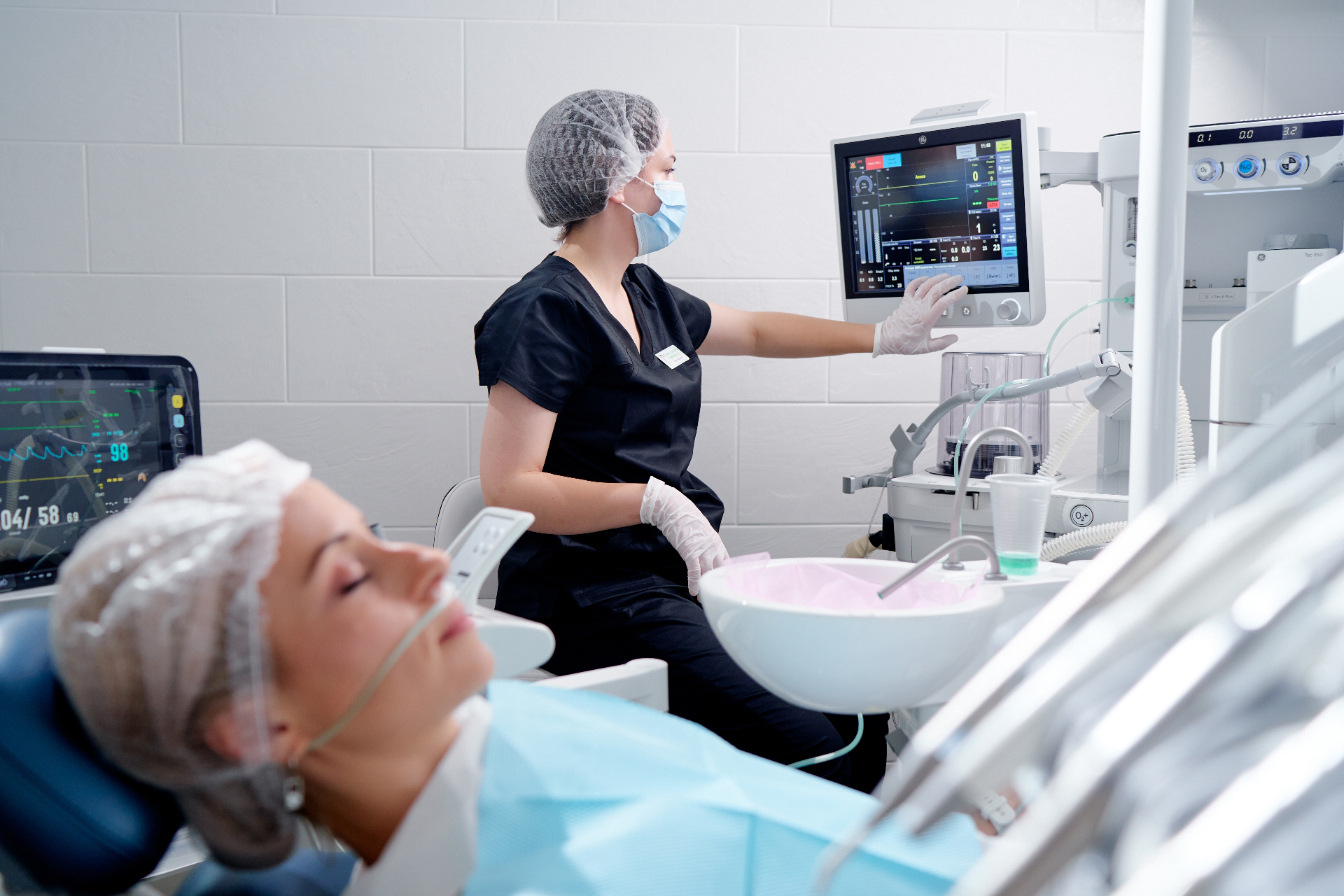
- IV moderate sedation. Medications delivered intravenously (typically midazolam, fentanyl, and propofol in some combination) produce a deeper sedated state while the patient still breathes on their own. This is the standard for most All-on-4 cases in the US and is also the option that requires the most careful planning for patients in recovery.
- General anesthesia. The patient is fully unconscious, typically in a hospital or accredited ambulatory surgery center with an MD anesthesiologist. Used selectively for the most complex cases or for patients whose sedation plan cannot be safely managed in an in-office setting.
A surgeon experienced with recovery patients will lay out which of these options are clinically appropriate for the specific case, which carry the highest relapse or interaction risk for the specific patient, and which protocols can be modified to remove or minimize the highest-risk components. There is almost always a safe pathway. It just may not be the default one.
Is IV sedation safe for someone in recovery from opioid addiction?
In most cases, yes, with planning. IV sedation for a patient in recovery from opioid use disorder is performed routinely at oral surgery practices around the country, and the published perioperative anesthesia literature supports it as safe when handled by an experienced provider.
The key adjustments typically include:
- Substituting or minimizing opioid components of the sedation cocktail. Fentanyl is the IV opioid most commonly used in dental sedation, and many surgeons will reduce or eliminate it for recovery patients in favor of higher reliance on propofol, dexmedetomidine, or ketamine, all of which produce sedation without acting on opioid receptors.
- Coordinating with the patient's addiction medicine provider before the procedure. A 10-minute call or written exchange between the oral surgeon and the patient's MAT prescriber or addiction medicine doctor is the single most useful planning step, and a good oral surgeon will initiate it rather than expecting the patient to broker it.
- Planning the post-op pain protocol in advance, not at discharge. The hours immediately after All-on-4 are when most patients are prescribed narcotic pain medication, and for a recovery patient that decision should be made before surgery, not improvised in the recovery chair.
- Designating a sober support person for the first 24 to 72 hours. Standard practice for any sedation is to have someone drive the patient home and stay with them overnight. For recovery patients, that person ideally should be someone who knows about the recovery history and can help monitor for any post-sedation emotional dysregulation, cravings, or sleep disruption.
Surgeons who do this work regularly often have a standard intake question about substance use history specifically because it changes the plan in concrete ways. If a surgeon's consultation never asks about it, that is information.
Can I have All-on-4 surgery if I'm on Suboxone, methadone, or Vivitrol?
Yes, and these cases are well-described in the medical literature. Each medication, however, has specific interactions that must be planned for. The short version of what changes:
Buprenorphine (Suboxone, Subutex, Sublocade, Brixadi)
Buprenorphine is a partial opioid agonist that binds tightly to opioid receptors, which means it can block the effect of other opioids given for pain or sedation. The current consensus in most perioperative anesthesia guidelines is to continue buprenorphine through the procedure rather than stopping it, because stopping carries a meaningful risk of relapse and abrupt loss of pain coverage. Surgeons and anesthesia providers will typically:
- Lean more heavily on non-opioid sedation agents (propofol, ketamine, dexmedetomidine).
- Use higher doses of full-agonist opioids if needed for breakthrough pain, since buprenorphine partially blocks their effect.
- Rely heavily on multimodal non-narcotic pain management for the post-op period (described in the next section).
- Coordinate with the patient's buprenorphine prescriber on dosing and timing around the procedure.
Methadone
Methadone is a full opioid agonist used both for opioid use disorder treatment and for chronic pain. Patients on a stable methadone dose are generally continued on their normal dose through the procedure, and additional short-acting analgesia is added on top as needed. The published perioperative methadone literature is consistent that abrupt discontinuation should be avoided. As with buprenorphine, coordination with the methadone clinic or prescriber before the procedure is the standard of care.
Naltrexone (Vivitrol, ReVia)
Naltrexone is an opioid antagonist, which means it blocks opioid receptors entirely. Patients on oral naltrexone or the monthly Vivitrol injection cannot effectively receive opioid pain medication while the drug is active. Surgeons will typically plan a non-opioid sedation and post-op pain protocol from the start, and in some cases coordinate with the prescriber to time the procedure relative to the most recent injection. Vivitrol's effects last roughly 28 days per injection.
For all three medications, the right move is to bring the prescriber and the oral surgeon into direct contact before the procedure. Most addiction medicine providers are accustomed to these consultations and respond quickly when an oral surgeon reaches out.
How does past benzodiazepine or alcohol use affect sedation?
Two distinct considerations come up here, and they are often more relevant than patients expect.
The first is tolerance. A patient with a history of regular benzodiazepine or heavy alcohol use, even years into recovery, may have residual cross-tolerance to benzodiazepine sedation drugs (midazolam, triazolam, diazepam) and to certain other sedatives. In practical terms, this means standard doses may be insufficient to produce the intended sedated state, and the anesthesia provider may need to titrate higher than expected, or switch to a different agent class entirely.
The second is relapse risk. For many patients in long-term recovery, benzodiazepines are a higher-risk medication class than opioids, both because they were the primary substance in some patients' addiction history and because the subjective experience of benzodiazepine sedation can be a powerful trigger. A patient in recovery from alcohol or benzodiazepine use disorder may reasonably prefer a sedation plan that avoids benzodiazepines entirely, even if it means a slightly different procedural experience.
The same alternatives apply. Propofol, dexmedetomidine, and ketamine produce sedation through different mechanisms than benzodiazepines and have no meaningful cross-reactivity with alcohol or benzodiazepine receptors. A surgeon comfortable with recovery patients will offer the option.
For patients with active alcohol use within the days before surgery, a separate set of considerations applies, including the risk of withdrawal during recovery. That conversation should happen with the surgeon and, ideally, with the patient's primary care or addiction medicine provider before scheduling.
What should I tell my oral surgeon about my history?
The honest answer is: everything that is clinically relevant. Specifically:
- The substance or substances involved, including legal and prescribed substances.
- Roughly how long the active use period lasted and how long ago it ended.
- Any current medication-assisted treatment (drug, dose, prescribing provider, and frequency).
- Any past adverse reactions to sedation, pain medication, or anesthesia.
- The name and contact information for any addiction medicine provider, therapist, or psychiatrist currently involved in care.
- Any preferences about post-operative pain management, including a preference for non-narcotic options.
- The name of a designated sober support person who will be available for the 72 hours after surgery.
This disclosure should happen at the consultation, not at the morning-of appointment. A surgeon who learns about a recovery history when the IV is already running cannot build the case around it. A surgeon who learns about it three weeks ahead of time can coordinate with the prescriber, modify the sedation plan, pre-order non-narcotic medications, and brief the surgical team.
The fear that disclosure will lead to being refused care is understandable but largely unfounded in modern oral surgery practice. Surgeons who treat recovery patients routinely have systems in place to handle the case well. Surgeons who do not should not be the surgeon for this case anyway, and that information is more useful to learn during a consultation than during a procedure.
What non-narcotic pain management options are available after All-on-4?
This is the question that matters most for many recovery patients, and the answer has gotten substantially better in the last five to ten years. A modern multimodal non-opioid pain protocol after All-on-4 surgery can keep patients comfortable for the first several days without prescription narcotics. The typical components:
- Long-acting local anesthetic at the time of surgery. Liposomal bupivacaine (Exparel) and other long-acting local anesthetics injected at the surgical sites can provide pain relief for up to 72 hours after the procedure, covering the most painful early window without systemic medication.
- Scheduled (not as-needed) ibuprofen plus acetaminophen. Alternating doses of 600 to 800 mg ibuprofen and 1000 mg acetaminophen on a fixed schedule has been shown in multiple dental pain studies to provide pain relief comparable to or better than low-dose opioid prescriptions, without the addiction risk.
- Anti-inflammatory steroids. A short course of oral dexamethasone or methylprednisolone reduces post-operative swelling, which is itself a major source of post-surgical discomfort.
- Cold therapy. Ice packs on the cheeks for the first 48 hours reduce both swelling and pain meaningfully.
- Soft diet and head elevation. Standard recovery hygiene that reduces post-op pain without medication.
- Topical anesthetic rinses. Lidocaine or benzocaine rinses for short-term relief during eating or hygiene.
For patients who choose not to use any prescription pain medication at all, this protocol works well for the large majority of All-on-4 cases. For patients who want a short backup prescription on hand "just in case," there are non-narcotic options (such as scheduled higher-dose NSAIDs combined with topical agents) that an oral surgeon can prescribe instead of opioids.
A comprehensive walkthrough of what the broader post-operative period looks like is available in the DID All-on-4 recovery guide, and the non-narcotic protocol described above slots into the standard recovery timeline.
How do I find an oral surgeon experienced with recovery patients?
Not every oral surgeon is equally experienced with this patient population. The qualifications and signals to look for go beyond standard implant credentials:
- Board certification in oral and maxillofacial surgery (ABOMS). This is the baseline credential for any complex implant case and is even more important when sedation planning is non-standard.
- Hospital privileges or affiliation with an accredited ambulatory surgery center. Provides a fallback setting if the case is better handled with general anesthesia or with more advanced monitoring than an in-office sedation suite can support.
- An MD anesthesiologist or CRNA on the surgical team, rather than the surgeon both operating and managing the sedation. For complex sedation plans, having a dedicated anesthesia provider is a significant safety upgrade.
- A written intake process that asks specifically about substance use history, current medications including MAT, and post-operative pain preferences. The presence of those questions on the intake form is itself a signal.
- Willingness to coordinate with the patient's addiction medicine provider before the procedure. Ask directly at the consultation: "Will you be in contact with my Suboxone prescriber before surgery?" The right answer is yes.
- Familiarity with multimodal non-opioid pain protocols, including liposomal bupivacaine and scheduled NSAID-acetaminophen combinations. A surgeon who has not heard of these is not the right surgeon for this case.
- A written post-operative pain plan provided before surgery. A specific plan, in writing, that the patient and their support person can review beforehand is far better than a verbal instruction at discharge.
The broader principles for evaluating any implant provider apply here, with these additional considerations layered on top. A surgeon who places implants well but does not handle sedation planning carefully is the wrong fit for a recovery patient. A surgeon who does both is worth traveling for.
It is also worth confirming that you are otherwise a candidate for the procedure. The standard medical, bone, and dental criteria are covered in the DID All-on-4 candidate guide, and addiction history alone does not disqualify anyone from being a candidate.

What questions should I ask at the consultation?
A focused list to bring to the consultation, designed to surface whether the surgeon handles these cases routinely or rarely:
- How often do you treat patients in recovery from substance use disorder, and what does your standard sedation plan modification look like for these cases?
- Will you coordinate directly with my addiction medicine provider before the procedure?
- Can you build a sedation plan that minimizes or eliminates opioids and benzodiazepines, and what would that plan look like?
- Do you use liposomal bupivacaine or other long-acting local anesthetics at the surgical sites?
- What is your standard non-narcotic post-operative pain protocol, and can you provide it to me in writing before surgery?
- Who is administering the sedation, and what is their credential?
- If I prefer no prescription narcotics at any point, can the entire case be managed with non-opioid options?
- What is your protocol if I experience unexpected cravings, anxiety, or sleep disruption in the days after surgery?
A surgeon who answers these clearly, without hesitation or defensiveness, is the kind of surgeon who handles these cases well. A surgeon who deflects, minimizes the question, or seems surprised by the depth of the conversation is signaling that this is not a routine case for them.
The Bottom Line
A history of addiction is not a barrier to getting All-on-4 surgery, and it should not be the reason a patient delays dental care they need. It is, however, a reason to be specific about who performs the surgery and how the sedation and post-operative pain plan are built. Surgeons who handle recovery patients routinely have well-established protocols, work in coordination with addiction medicine providers, and offer non-narcotic options as a standard part of their practice. The right surgeon will treat the disclosure as useful clinical information, not as a reason to refuse care, and the right plan will protect the recovery as carefully as it protects the surgical outcome. And when you are ready, find qualified providers near you at Dental Implant Directory.
Ready to find a qualified provider?
Search our independent directory of dental implant providers organized by specialty, location, and credentials.